
Conclusion
Leopardwood offers a unique combination of visual appeal and tonal characteristics that make it a desirable choice for acoustic guitars. Its striking spotted figure sets it apart from other tonewoods, while its bright and clear tone provides a balanced and articulate sound.
While it can be a bit more challenging to work with than some other woods, the results are well worth the effort for luthiers who appreciate its beauty and sonic properties. If you’re looking for an acoustic guitar that stands out from the crowd and offers a unique playing experience, a leopardwood acoustic guitar may be just what you need.
Consider exploring the world of leopardwood acoustic guitars to discover the possibilities. Its unique combination of beauty and tone makes it a truly special tonewood.
Whether you’re a seasoned player or just starting out, a leopardwood guitar can inspire you to create beautiful music. Its distinctive appearance and clear tone will set you apart from the crowd.
Take the time to research different luthiers and manufacturers who work with leopardwood. Find an instrument that speaks to you and that fits your playing style and tonal preferences.
Leopardwood is a striking tonewood that has been gaining popularity among luthiers and guitar enthusiasts. Its distinctive spotted figure resembles the coat of a leopard, making it a visually appealing choice for acoustic guitars.
But beyond its looks, what does leopardwood bring to the table in terms of sound and workability? This guide will explore the properties of leopardwood, its uses in acoustic guitar construction, and how it compares to other tonewoods.
Whether you’re a seasoned luthier or simply curious about the different woods used in guitars, this article will provide valuable insights into the world of the leopardwood acoustic guitar. Let’s uncover what makes this spotted wood a unique and desirable option for crafting beautiful sounding instruments.
Leopardwood: Identifying Characteristics and Origin
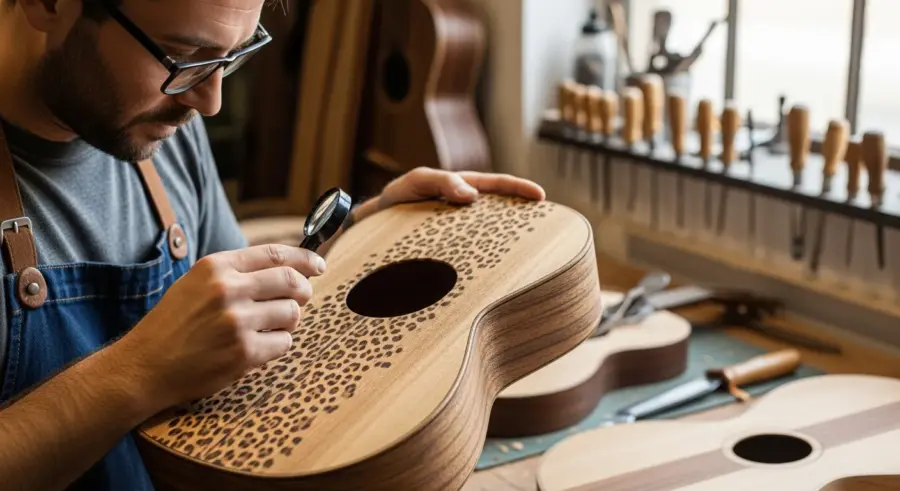
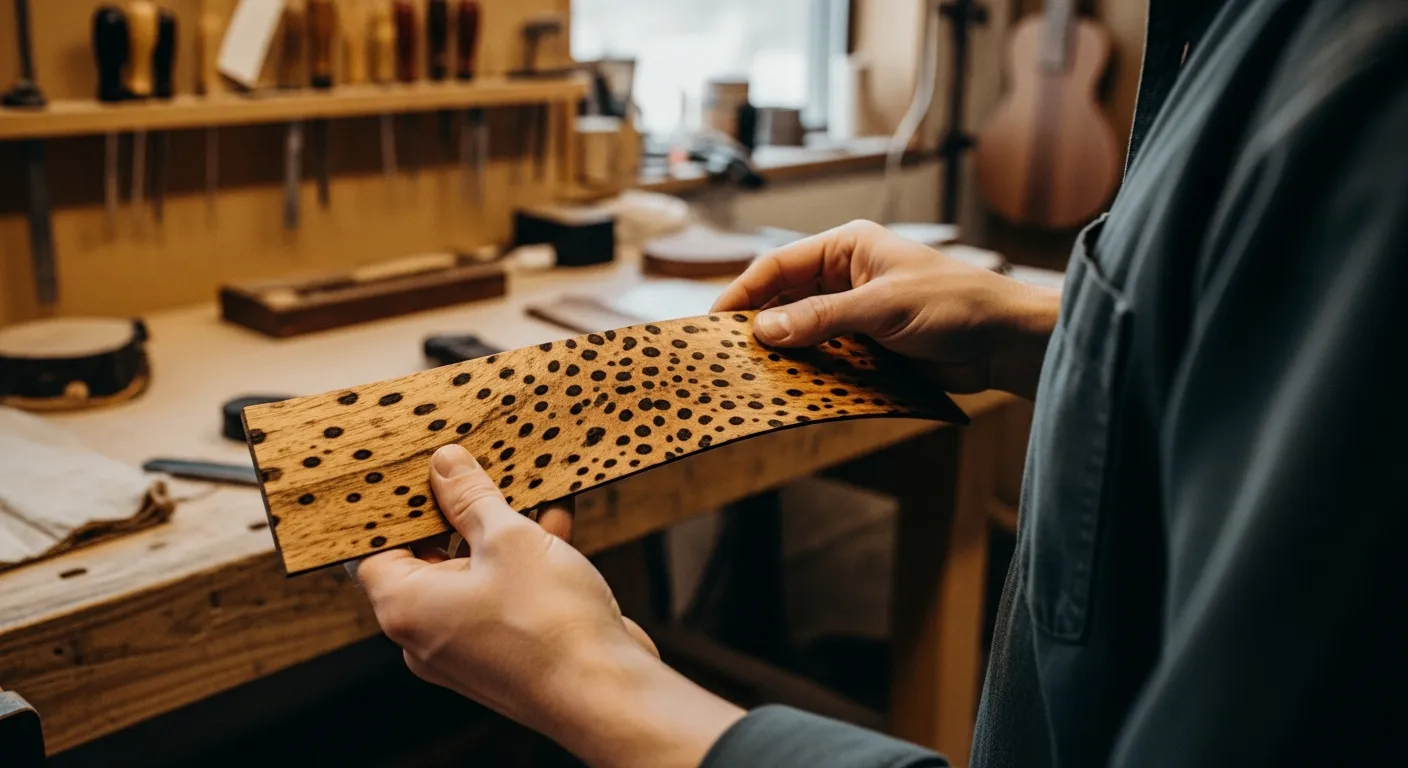
Leopardwood, scientifically known as Roupala montana, is a hardwood native to South America, primarily found in Brazil, Guyana, and Suriname. The name “leopardwood” comes from its most recognizable feature: a prominent ray fleck pattern that resembles the spots of a leopard.
These spots are actually medullary rays, which are radial sheets of cells that extend perpendicularly to the growth rings of the tree. In leopardwood, these rays are unusually large and pronounced, creating the wood’s signature look.
The wood itself is a medium to dark reddish-brown, providing a nice contrast to the lighter colored spots. Leopardwood is a dense and heavy wood, typically weighing around 55 pounds per cubic foot when dry.
This density contributes to its strength and stiffness, making it suitable for use in musical instruments. Beyond its distinctive figure, leopardwood is also known for its hardness, which can make it a bit more challenging to work with compared to softer tonewoods.
The unique cellular structure of leopardwood also plays a role in its workability. The interlocked grain can cause issues during planing and sanding if not addressed properly. Understanding these characteristics is crucial for achieving a professional finish.
The origin of the wood also affects its quality. Leopardwood sourced from different regions can exhibit variations in color, density, and figure. Reputable suppliers will be able to provide information about the wood’s provenance.
Furthermore, the age of the tree at the time of harvesting can influence the wood’s stability and tonal properties. Older, more mature trees tend to yield wood that is more stable and resonant.
Identifying genuine leopardwood is also important, as some other woods may be marketed as leopardwood due to similar, though less pronounced, spotting. A careful examination of the ray fleck pattern and wood density can help ensure you are getting the real deal.
Tonal Qualities of Leopardwood in Acoustic Guitar Construction
When used in acoustic guitar construction, leopardwood is generally known for producing a bright and clear tone. It tends to emphasize the higher frequencies, resulting in a sound that is articulate and well-defined.
Many luthiers and players describe the leopardwood sound as having a good balance of warmth and projection. While it may not have the deep, resonant bass of some other tonewoods like rosewood, leopardwood compensates with its clarity and responsiveness.
The density of leopardwood contributes to its ability to reflect sound waves efficiently. This results in a guitar with good sustain and a lively, responsive character that is suitable for a variety of playing styles.
Fingerstyle players often appreciate the clarity and note separation that leopardwood provides. Strummers might find that it offers a balanced and articulate sound that cuts through a mix.
The brighter tonal characteristics of leopardwood make it a good match for players who prefer a more modern sound. It can also be a good choice for recording, as its clarity helps each note stand out in the mix.
Leopardwood’s responsiveness makes it well-suited for guitars with smaller bodies. The wood’s ability to project sound efficiently helps to compensate for the smaller sound chamber.
However, it’s important to note that the tonal qualities of any guitar are influenced by a variety of factors, including the top wood, bracing pattern, and overall construction. Leopardwood’s contribution to the sound is just one piece of the puzzle.
Experimenting with different combinations of tonewoods is key to finding the perfect sound for your playing style. Leopardwood can be a valuable addition to your tonal palette.
Working with Leopardwood: Achieving a Smooth Surface
Leopardwood can be a bit tricky to work with due to its hardness and interlocked grain. These properties can make it prone to tearout during machining and sanding if proper techniques are not employed.
Sharp tools are essential when working with leopardwood. Dull blades will only exacerbate the tendency for the wood to chip and splinter, leading to frustration and a less-than-perfect finish.
| Operation | Recommended Technique | Reason |
|---|---|---|
| Sawing | Use a fine-toothed blade with a slow feed rate | Minimizes tearout and chipping |
| Planing | Take shallow passes with a sharp, well-tuned plane | Prevents the plane from digging in and causing damage |
| Sanding | Start with a medium grit and gradually move to finer grits | Ensures a smooth, even surface without deep scratches |
| Finishing | Apply a sanding sealer before the final finish | Helps to fill the pores and prevent the finish from sinking in |
Sanding leopardwood requires patience and a methodical approach. Starting with a medium grit sandpaper and gradually working your way up to finer grits is the best way to achieve a smooth, glass-like surface.
Using a card scraper can be beneficial for removing imperfections and smoothing the surface before sanding. A properly sharpened and burnished scraper can produce a very clean and even cut.
When sanding, it’s important to sand with the grain to avoid creating scratches. Using a sanding block can help to distribute pressure evenly and prevent dips or unevenness.
Applying a sanding sealer before the final finish is crucial for filling the pores of the wood and preventing the finish from sinking in. This will result in a smoother and more even finish.
Experimenting with different sanding techniques and abrasives is key to finding the best approach for your particular piece of leopardwood. Practice on scrap pieces before working on the final project.
Leopardwood’s Visual Appeal and Grain Patterns
The visual appeal of leopardwood is undeniable. The striking spotted figure is unlike any other tonewood, making it a popular choice for luthiers looking to create unique and eye-catching instruments.
The size and density of the spots can vary depending on the specific piece of wood. Some pieces may have small, tightly packed spots, while others may have larger, more widely spaced spots.
The orientation of the wood also affects the appearance of the figure. Quartersawn leopardwood will display the most prominent spotting, as the medullary rays are oriented perpendicular to the surface of the wood.
Flat sawn leopardwood will still exhibit some spotting, but the figure will be less pronounced and more elongated. Luthiers often carefully select and match leopardwood sets to create visually stunning backs and sides for acoustic guitars.
The color of the wood can also vary from a light reddish-brown to a darker, richer hue. This variation adds to the wood’s natural beauty and makes each piece unique.
Some pieces of leopardwood may also exhibit subtle figuring beyond the spotting, such as curl or flame. These additional features can further enhance the wood’s visual appeal.
The way the wood is finished can also impact its appearance. A high-gloss finish will accentuate the wood’s figure and bring out its natural colors.
A satin finish will provide a more subtle and understated look. Ultimately, the choice of finish depends on the desired aesthetic of the instrument.
Using Leopardwood for Backs, Sides, and Tops
Leopardwood is most commonly used for the backs and sides of acoustic guitars. Its density and stiffness contribute to a bright and focused sound, which can complement a variety of top woods.
When paired with a softer top wood like cedar, leopardwood can add clarity and projection to the overall tone. When combined with a stiffer top wood like spruce, it can create a balanced and articulate sound with plenty of headroom.
- Back and sides for projection
- Bright and clear tone
- Adds clarity to cedar tops
- Balances spruce tops
- Eye-catching visual appeal
While less common, leopardwood can also be used for guitar tops. However, its density can make it less responsive than traditional top woods like spruce or cedar.
If using leopardwood for a top, it’s important to carefully select a piece that is relatively lightweight and resonant. Thinning the top can also help to improve its responsiveness.
Leopardwood can also be used for other parts of the guitar, such as the neck or headstock. Its strength and stability make it a suitable choice for these components.
The visual appeal of leopardwood can be enhanced by using it in combination with other tonewoods that complement its color and figure. For example, a leopardwood back and sides can be paired with a spruce top and a mahogany neck.
Ultimately, the best way to determine whether leopardwood is right for your guitar is to experiment with different combinations and listen to the results. Each piece of wood is unique, so it’s important to find the right match for your playing style and tonal preferences.
Leopardwood vs. Other Figured Tonewoods
Leopardwood is often compared to other figured tonewoods like figured maple, koa, and rosewood. Each of these woods has its own unique tonal and visual characteristics.
Figured maple is known for its bright and clear tone, similar to leopardwood, but it tends to be less dense and easier to work with. Koa offers a warm and balanced tone with a distinctive shimmer, and its figure can range from subtle to highly flamed.
Rosewood is prized for its deep, resonant bass and complex overtones, and its figure can range from straight-grained to highly figured with swirling patterns. Compared to these woods, leopardwood stands out with its unique spotted figure and its bright, focused tone.
While it may not have the warmth of koa or the bass of rosewood, leopardwood offers a clarity and articulation that is all its own. Ultimately, the choice of tonewood depends on the desired sound and aesthetic of the instrument.
Compared to mahogany, leopardwood is generally brighter and more articulate, while mahogany offers a warmer and more fundamental tone. Mahogany is also typically easier to work with than leopardwood.
Walnut is another figured tonewood that is sometimes compared to leopardwood. Walnut offers a balanced tone with good clarity and warmth, and its figure can range from straight-grained to highly figured with curl or burl.
Compared to walnut, leopardwood is generally brighter and more focused, while walnut offers a more balanced and versatile tone. The choice between these woods depends on the player’s individual preferences.
Consider the overall sound you are trying to achieve when selecting a tonewood. Experimenting with different combinations of woods is key to finding the perfect match for your playing style.
The Sustainability and Availability of Leopardwood
As with any tonewood, it’s important to consider the sustainability and availability of leopardwood. Roupala montana is not currently listed as an endangered species, but responsible sourcing is still crucial.
Look for suppliers who practice sustainable forestry and who can provide documentation of the wood’s origin. This ensures that your guitar is not contributing to deforestation or habitat loss.
The availability of leopardwood can fluctuate depending on market demand and harvesting practices. It is generally less common than more widely used tonewoods like mahogany or maple, but it is typically available from specialty wood suppliers.
Be prepared to pay a premium for leopardwood, as its unique figure and relative scarcity can drive up the price. However, many luthiers and players feel that the visual and tonal qualities of leopardwood are well worth the investment.
Supporting sustainable forestry practices helps to ensure the long-term availability of leopardwood and other valuable tonewoods. Look for certifications such as FSC (Forest Stewardship Council) when purchasing wood.
Consider purchasing wood from suppliers who are committed to responsible harvesting and replanting. This helps to protect the environment and support local communities.
Educate yourself about the different types of wood and their environmental impact. Making informed choices can help to promote sustainable practices in the guitar industry.
By choosing sustainably sourced leopardwood, you can enjoy its beauty and tonal qualities with a clear conscience. You’ll know that your guitar is not contributing to deforestation or habitat loss.
Finishing Techniques to Enhance Leopardwood’s Beauty
The finish you choose for your leopardwood acoustic guitar can greatly enhance its beauty and protect the wood from damage. A clear finish is typically recommended to showcase the wood’s natural color and figure.
Nitrocellulose lacquer is a popular choice among luthiers for its ability to bring out the depth and clarity of the wood. However, it can be more prone to cracking and yellowing over time compared to other finishes.
Polyurethane finishes are more durable and resistant to scratches and chemicals. They can also provide a high-gloss sheen that accentuates the leopardwood’s figure.
Epoxy finishes are another option, offering excellent protection and clarity. However, they can be more difficult to apply and may not have the same warmth and depth as lacquer or polyurethane.
Oil finishes can also be used to enhance the beauty of leopardwood. These finishes penetrate the wood and provide a natural look and feel.
However, oil finishes offer less protection than lacquer or polyurethane. They may require more frequent maintenance to keep the wood looking its best.
Before applying any finish, it’s important to properly prepare the surface of the wood. This includes sanding to a smooth, even surface and removing any dust or debris.
Applying multiple thin coats of finish is generally better than applying one thick coat. This helps to prevent runs and drips and results in a smoother, more even finish.
Notable Leopardwood Acoustic Guitar Examples
While not as ubiquitous as some other tonewoods, there are several notable examples of leopardwood acoustic guitars. Many custom luthiers have used leopardwood to create stunning and unique instruments for discerning players.
Some manufacturers have also incorporated leopardwood into limited-edition models, showcasing its visual appeal and tonal characteristics. These guitars often command a higher price due to the rarity and beauty of the wood.
Keep an eye out for guitars built by boutique builders, as they are more likely to experiment with less common tonewoods like leopardwood. These instruments often represent the pinnacle of craftsmanship and offer a truly unique playing experience.
Online forums and guitar shows are also great places to discover leopardwood acoustic guitars. You might even find a hidden gem that perfectly matches your tonal and aesthetic preferences.
Researching different luthiers and manufacturers can help you find examples of leopardwood guitars. Look for reviews and testimonials from other players to get a sense of the instrument’s quality and sound.
Visiting guitar stores and attending guitar shows can give you the opportunity to see and play leopardwood guitars in person. This is the best way to experience the wood’s unique visual and tonal qualities.
Consider commissioning a custom-built leopardwood guitar to get an instrument that is tailored to your specific needs and preferences. This allows you to choose the exact specifications of the guitar, including the tonewoods, bracing pattern, and finish.
Owning a leopardwood acoustic guitar is a great way to express your individuality and appreciation for fine craftsmanship. It’s an instrument that is sure to turn heads and inspire your playing.
Maintaining Your Leopardwood Acoustic Guitar
Like any acoustic guitar, a leopardwood instrument requires proper care and maintenance to ensure its longevity and optimal performance. Regular cleaning and humidification are essential to prevent damage from dirt, dust, and changes in humidity.
Use a soft, lint-free cloth to wipe down the guitar after each playing session. This will remove fingerprints, sweat, and other debris that can dull the finish and corrode the hardware.
Invest in a good quality guitar humidifier to maintain the proper humidity level, especially during dry winter months. Low humidity can cause the wood to dry out and crack, while high humidity can lead to swelling and warping.
Store your guitar in its case when not in use to protect it from bumps, scratches, and extreme temperatures. With proper care, your leopardwood acoustic guitar will provide you with years of playing enjoyment.
Change your guitar strings regularly to maintain optimal tone and playability. Old strings can become dull and lifeless, affecting the sound of the instrument.
Have your guitar professionally set up by a qualified luthier to ensure that it is properly adjusted for optimal playability. This includes adjusting the action, intonation, and neck relief.
Avoid exposing your guitar to extreme temperatures or humidity changes. These conditions can damage the wood and finish.
By following these simple maintenance tips, you can keep your leopardwood acoustic guitar looking and sounding its best for years to come. Proper care is essential for preserving the value and playability of your instrument.
Conclusion
Leopardwood offers a unique combination of visual appeal and tonal characteristics that make it a desirable choice for acoustic guitars. Its striking spotted figure sets it apart from other tonewoods, while its bright and clear tone provides a balanced and articulate sound.
While it can be a bit more challenging to work with than some other woods, the results are well worth the effort for luthiers who appreciate its beauty and sonic properties. If you’re looking for an acoustic guitar that stands out from the crowd and offers a unique playing experience, a leopardwood acoustic guitar may be just what you need.
Consider exploring the world of leopardwood acoustic guitars to discover the possibilities. Its unique combination of beauty and tone makes it a truly special tonewood.
Whether you’re a seasoned player or just starting out, a leopardwood guitar can inspire you to create beautiful music. Its distinctive appearance and clear tone will set you apart from the crowd.
Take the time to research different luthiers and manufacturers who work with leopardwood. Find an instrument that speaks to you and that fits your playing style and tonal preferences.